Printed fromChabadNaples.com
ב"ה

Rabbi Fishel's Blog

America’s Blessing, Our Responsibility

Dear Friends,

This Shabbat, as America marks 250 years since the Declaration of Independence, we pause to appreciate one of the greatest blessings a person, a family, and a community can know: the blessing of freedom.

There will be flags, family, barbecues, and fireworks. But July 4th is more than a national celebration. It is a moment for all of us to recognize the freedom, opportunity, and dignity this country represents.

For us as Jews, that appreciation runs especially deep. For so much of our history, Jewish life was lived under fear, restriction, or uncertainty. Here in America, we have been blessed with the freedom to live openly and proudly as Jews. We can build a synagogue, place a mezuzah on our doors, educate our children, gather for Shabbat, serve Hashem with confidence, build communities, and be there for one another. That is a blessing we should never take for granted.

From its founding, America recognized a powerful truth: our rights and dignity are not given by government alone. They are endowed by our Creator. Every person has value because every person was created by Hashem.

Freedom built on that foundation is not only a privilege. It is a responsibility. This week’s Torah portion, Pinchas, speaks directly to that responsibility. Moses is told that he will not enter the Land of Israel. This was the dream of his life. He had led the Jewish people out of Egypt, through the sea, to Mount Sinai, and across the desert. And now, at the very edge of the Promised Land, he learns that he will not go in.

What does Moses do at that moment?

He does not focus on himself. He turns to Hashem and asks for the next leader.

He says:

יִפְקֹד ה׳ אֱלֹקי הָרוּחֹת לְכָל בָּשָׂר

“May Hashem, the G-d of the spirits of all flesh, appoint a man over the community.”

And he asks that the people not be left “like sheep without a shepherd.”

Moses understood something powerful. Life is not only about what we build. It is about what we leave for the next generation. That is true for the Jewish people, and it is true for America.

Freedom is precious, but it is never automatic. It must be cherished, protected, and passed on with responsibility. At a time when antisemitism is rising and moral clarity is needed, we must continue to stand proudly for the values that make this country a blessing: faith in the Creator, respect for every person, moral courage, kindness, and the willingness to stand up for what is right.

That is one of the messages of Pinchas: there are moments when values require courage. We cannot be passive about the future of our people, our families, or our communities.

So this July 4th, we do not only look back with gratitude. We look forward with purpose. What kind of country will we help build? What kind of community will we leave behind? What values will our children and grandchildren see in us?

The answer begins with how we use our freedom. Use it to do a mitzvah. Use it to help another person. Use it to build family and community. Use it to bring more light into the world. That is the spirit we try to live every day at Chabad Naples. Every person is cherished. Every soul is precious. Our hope is that everyone feels loved, welcomed, and part of one mishpacha, one extended family.

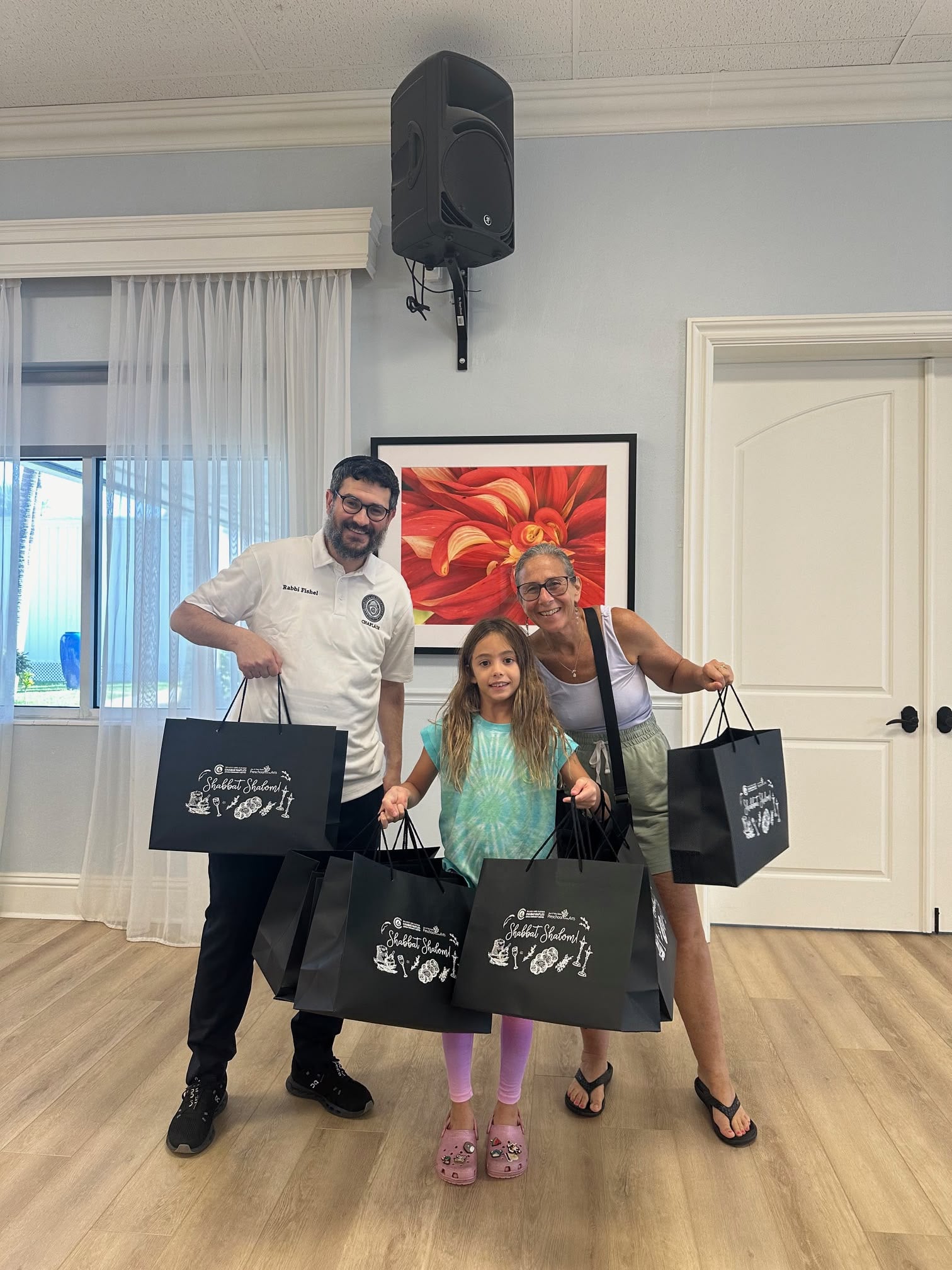
We felt that so powerfully this week with the launch of Kitchen of Kindness. The response was beautiful because it was not only about meals. It was about people being cared for, feeling connected, and knowing they are part of a community that shows up for one another.

That is freedom at its best: using the blessings we have been given to bring kindness, dignity, and goodness into the lives of others.

May Hashem bless this country, protect those who defend it, and help each of us use our freedom with purpose, gratitude, courage, and kindness.

With love and blessings,

Rabbi Fishel and Ettie Zaklos

A Quiet and Sacred Kindness

Some of the most meaningful work of a rabbi and a Jewish community happens away from public view.

For the past 23 years, devoted volunteers from our Chabad Naples family have helped serve through our Chevra Kadisha, the holy burial society.

Our committed volunteers just had the merit of performing the mitzvah of taharah for a beloved member of our community. Taharah is the traditional preparation of a person for burial, done with dignity, sensitivity, prayer, and deep respect.

In Jewish tradition, the body is treated with tremendous honor. It was the partner of the soul in every good deed a person did in this world. It was how a person gave a hug, offered a smile, held a child, gave charity, lit Shabbat candles, helped another person, and brought goodness into the world.

The neshamah, the soul, continues its journey. Through taharah, we accompany the person with love and dignity into the next stage of its eternal journey. Our sages call this a חסד של אמת, a chesed shel emes, “a true kindness,” because it is done for someone who can no longer say thank you.

With heartfelt gratitude to these devoted members of our community, and to all those who have helped with this holy work over the years.

A special thank you to Ettie for leading and coordinating the women’s Chevra Kadisha with devotion, sensitivity, and care.

May Hashem bless them for this holy work, and may every soul be elevated through the honor and compassion shown by our community.

Weekly.jpeg 

The Tent Next Door

Dear Friends, AKK great pic.jpg

If you walk into our sanctuary and look above the Ark, you will see the Hebrew words:

מַה טֹּבוּ אֹהָלֶיךָ יַעֲקֹב, מִשְׁכְּנֹתֶיךָ יִשְׂרָאֵל

“How good are your tents, O Jacob, your dwelling places, O Israel.”

In 2017, we undertook a major renovation of our sanctuary, with the Elias and Yitzchak families stepping forward to help lead the way together with our community. It transformed the space into the beautiful prayer space it is today, a place that welcomes large crowds every Shabbat and so many meaningful moments throughout the year.

As part of that renovation, we carefully chose which verse would be placed above the Ark. There are many beautiful verses that could have been chosen. But we chose these words from this week’s Torah portion, Balak.

In this week’s portion, King Balak hires Balaam, a powerful prophet, to curse the Jewish people. But when Balaam looks out at the Jewish camp, he cannot curse them. Instead, he blesses them.

What did he see?

Our sages explain that he saw the way the Jewish people arranged their tents. The entrances did not face one another. One family was not looking into another family’s home. One person was not busy measuring, comparing, or peering into someone else’s life.

He saw dignity, modesty, and respect. He saw families focused on their own purpose, their own mission, their own home.

That itself was the blessing. And what a message for our time.

We live in a world where so much of life is about looking into someone else’s tent. What are they doing? Where are they going? What do they have? What did they post? How do we compare?

Of course, technology can be used for good. It’s how I share this message with you. But the Torah reminds us that the deepest blessing comes when we know how to build our own tent with peace, purpose, and holiness. Our children need that. Our families need that. We all need that.

We need places where people are not competing, performing, or comparing. Places where they can belong. Places where they can breathe. Where kindness, learning, joy, and care are part of daily life. That is what we try to build every day at Chabad Naples.

Walk into Chabad Naples on any given day and you will see it. Children learning and growing. Seniors being visited and remembered. Families gathering. People being helped. And we continue looking for new ways to bring that blessing to others.

That is why we just launched Kitchen of Kindness, a new way to bring warmth and care directly to those who need it. Volunteers will come together to cook, pack, and deliver fresh food with dignity and love. Because it is never just about the food. It is a message: you are seen, you are cared for, you are not alone.

This is how we continue building tents: more places of warmth, more spaces of kindness, and more ways to bring blessing into people’s lives.

Balaam saw the Jewish people from afar and said, “How good are your tents.”

Thousands of years later, our job is to continue building those tents. In our homes. In our community. In the way we treat each other.

So let us take this verse to heart.

Let us build homes and spaces where our children feel grounded, not pressured. Where families feel connected, not compared. Where each person can live their mission with confidence, dignity, and joy.

How good are your tents. That is the blessing. And that is the work.

Wishing you a Shabbat of peace, purpose, and blessing,

With love and blessings,

Rabbi Fishel & Ettie Zaklos

Message.jpeg

Who told you you’re small?

Dear Friends, Yechiel.JPG

There is a certain way a person behaves when they feel small.

The shoulders bend a little. The voice becomes quieter. The eyes look down. Even before anyone says anything, the person has already started imagining what everyone else must be thinking.

We have all experienced this in some way. A person walks into a room and assumes they do not belong. A student looks at a challenge and decides they are not capable. A Jew sees the world around them and wonders, “Wouldn’t it be safer to stand a little smaller, speak a little softer, hide a little more?”

But this week’s Torah portion reminds us that how we see ourselves matters.

The Torah tells us about the spies who were sent to scout the Land of Israel. These were not ordinary people. They were leaders and people of stature. Each chosen to represent their tribes and bring back a report. And yet, when they returned, they said something very revealing.

“We were like grasshoppers in our own eyes, and so we were in their eyes.”

That part we can understand. They were frightened. They felt small. They looked at the fortified cities and the powerful people and they lost confidence.

But then they added, “and so we were in their eyes.” How did they know what the people of the land thought of them?

The answer is that they didn’t really know. They were speaking from their own fear. Because when a person sees themselves as small, they begin to believe that everyone else sees them that way too. Since they saw themselves as grasshoppers, they assumed the world saw them as grasshoppers as well.

That was the mistake of the spies. Not that they saw giants. Rather, that they forgot who sent them. They forgot that they were not going on their own strength alone. They were sent by God. They were part of a Divine mission. And when you know Who sent you, you do not have to see yourself as a grasshopper.

This is about quiet strength and faith. It is about feeling fear and still remembering that each of us was placed in this world with purpose.

Every person has a mission. Every soul has something only it can bring into the world. A kindness only you can give. A mitzvah only you can do. A corner of the world that needs the strength, warmth, and light that God gave specifically to you.

We all know the first words we say when we wake up: Modeh Ani. We thank Hashem for returning our soul to us.

But our Sages also teach us something else about the way we begin the day. We are told to rise with strength, like a lion, to serve our Creator. Not like a grasshopper. Like a lion.

Waking up is not only about our faith in God. It is also a reminder that God has faith in us. If He gave me another morning, another breath, another day, then there is something He wants from me today.

When we remember that, we carry ourselves differently. We speak with more courage. We live with more purpose.

This is also why a birthday is so meaningful. A birthday is not only a day to receive good wishes. It is a day to ask: why was I born? What is the mission God placed in my hands? What more can I give? What more can I become?

My Hebrew birthday was this week, and it gave me the opportunity to go to the Rebbe’s Ohel for a few hours and reflect on this very question.

The Rebbe taught us again and again that every person is here with purpose. Every Jew has a mission. We are not meant to see ourselves as small. We are meant to stand tall, with humility, with faith, and with the knowledge that God placed us here for a reason.

From there, I went to Washington, DC, to spend a day at the Living Legacy conference, honoring the Rebbe’s legacy ahead of his anniversary of passing this coming Thursday. It was powerful to see leaders, senators, congresspeople, and public officials from across the aisle speak about the Rebbe, about his vision, and about the impact he continues to have on the world.

But one moment stood out deeply.

Yechiel Leiter, Israel’s ambassador to the United States, addressed the gathering. He is a man who has known tremendous personal pain. His son, Moshe, was killed in Gaza. And yet, as he stood there, what came through was not weakness. It was strength. Conviction. Faith. Responsibility. A sense that even after loss, there is still a mission. He spoke with the poise of someone who knows what he stands for.

That image stayed with me. Because now more than ever, we need that kind of posture. As Jews, parents, friends, and members of a community. As human beings.

We cannot walk through life hunched over, doubting whether we matter, wondering if we have permission to make a difference.

Our families, our communities, and our mission need us to stand with humility and strength.

God asks us to be humble, yes. But humility does not mean thinking we are nothing. True humility means knowing that whatever strength we have was given to us by God, and therefore must be used.

So much of our fear comes from imagined eyes. What will they think? What will they say? How will they see me? That was the mistake of the spies. Since they saw themselves as grasshoppers, they believed the world saw them that way too.

But the Torah teaches us to begin somewhere else. Begin with how God sees us.

God sees souls with purpose. People capable of courage, growth, kindness, and holiness. People who can enter the world as partners in making it better.

So this week, let us ask ourselves: Where have I been seeing myself as too small? Where is God asking me to stand taller, speak with more courage, and live with more purpose?

We are the children of God. We are sent with a mission. We are given another morning, another breath, another opportunity to bring goodness into the world.

May we see ourselves the way God sees us. May we stand tall in our purpose, strong in our values, and proud in our Judaism. And may we use the mission we have been given to bring more light, strength, and goodness to ourselves, our families, our community, Israel, and the entire world.

With faith, resilience, and all the blessings,

Rabbi Fishel and Ettie Zaklos

Carry Light. Give Water.

Dear Friends, 

A person can carry many things. Some things we carry in our pockets. Some things we carry in our hearts. Some things we carry for ourselves, and some things we carry for others.

A child can happily carry a dirty pebble found outside, a small toy, or a piece of candy discovered at the bottom of a backpack. To an adult, it may look like nothing. But to the child, it has value. Not because of what it costs. Rather, because it was noticed and chosen, it became something worth holding onto.

As we get older, the things we carry change.

We carry a smartphone, keys, a wallet, and two to three types of glasses. These are useful, necessary things. Things whose value has already been decided for us and marked in ink on a price tag. But the Torah reminds us, especially as we get older, that there is another kind of value. Beyond what something costs, the value of what it can do. A small match may not be worth much in a store. But in the right moment, it can bring light, warmth, and life.

And this week, the Torah reminds us that every Jew carries that kind of power.

The Torah speaks about the lighting of the Menorah. Aharon is commanded to raise the flames. Not simply to light them, but to lift each flame until it can burn on its own.

At first glance, we may think this mission belongs only to Aharon. He was the Kohen Gadol. He lit the Menorah in the Mishkan. He served in the holiest place on behalf of the Jewish people.

But the Rebbe often taught that the message of the Menorah belongs to every one of us. Every Jew is a flame. Every soul has its own G-d-given purpose, its own color, its own movement, its own way of bringing light into the world.

No two flames are the same. Some people bring light through generosity. Some through wisdom. Some through friendship. Some through quiet kindness. Some through strength. Some through warmth. Some through simply making another person feel seen.

And that is why every Jew, regardless of title, is entrusted with light. Because each of us meets people along the way. A neighbor. A friend. A family member. A stranger. Someone who needs a kind word, a listening ear, a gentle smile. Each one is a reminder that every person matters.

The question is not only what we carry for ourselves. The question is whether we realize what we carry for others.

This past week, our community lost two special people, each one a light in his own way.

Our dear friend and member of Chabad Naples, Stanley Star, passed away on Thursday night. As a rabbi, there are moments of great joy, and there are moments that are deeply difficult. There are lifecycle events filled with celebration, and there are moments when we sit with families in their pain and try to be present.

I traveled to New York to be with his family and officiate Stanley’s funeral. The service was scheduled to begin at 10 o’clock, but it did not begin until nearly an hour later. There were lines and lines of people coming to pay their respects. Firefighters, friends, neighbors, community members, one person after another, each one carrying a story of how Stanley had touched their life. It was incredibly powerful to see.

Stanley was a man of generosity, a philanthropist, a person known and respected in his community in Fredonia, New York, and here in Naples as well. Together with his wife, Elizabeth, he touched many lives. But more than what he accomplished, people spoke about who he was.

He had a way of making people feel seen and valued. His employees spoke about how he treated them like family. With dignity and respect. No matter his success, he remained approachable and real. And even long after he had stepped away, many of them still came, years later, to pay their respects.

That says something powerful about a person. How he lifted others and strengthened a community. How he used what he had to bring warmth, support, and dignity to those around him.

Stanley understood what it meant to carry light.

We also remember Paul Kane, who passed away at the age of 99. He lived just a few doors away from Chabad, and over the years he became very dear to us.

About seven years ago, Paul celebrated his first Bar Mitzvah. He was 93 years old! Imagine that. A man later in life, still growing, still reaching, still connecting, still adding light.

And he did not stop there.

Even nearing 100, he was still going to the gym. I would sometimes meet him there. We would sit together. We would talk for a long time. We connected, and in fact, we spoke just before Shavuot. Our children would visit and bring him challah. He was warm. He was present. He had a glow about him.

Stanley and Paul lived very different lives. They gave in different ways. But each one carried something precious.

Stanley carried generosity, responsibility, and a heart for the community. Paul carried warmth, friendship, and the energy and inspiring curiosity of someone decades younger. Each one, in his own way, was both a flame and a lamplighter.

And that is the lesson for all of us.

There is an old thought: a person can build a monument, or a person can dig a well.

A monument may stand through the test of time. It may even be beautiful. But a well gives water. It nourishes people. It continues to help others live and grow long after the one who dug it is gone.

That is the difference between asking the world to remember us and giving the world something it can carry forward.

Let us be well diggers. Let us live in a way that nourishes others, bringing warmth where there is loneliness, encouragement where there is doubt, and light where there is darkness.

So this week, let us ask ourselves: what do we carry with us?

Do we carry patience? Kindness? The courage to call someone, visit someone, encourage someone, forgive someone, help someone? Do we carry a mitzvah ready to be shared? Every day, Hashem places someone in our path whose flame we can help lift.

May the neshamas of Stanley Star and Paul Kane have an aliyah. May their families be comforted. And may each of us honor their memory by becoming lamplighters in our own way, not living for monuments, but digging wells, nourishing others with warmth, goodness, and light.

With faith, resilience, and all the blessings,

Rabbi Fishel and Ettie Zaklos

The world counts followers. G-d counts souls.

Dear Friends, 

We are now studying the Book of Numbers, which details a census that is taken of the Children of Israel during their time in the Sinai desert.

It is an often-overlooked passage in the Torah that gives us pause. Did Moses have nothing better to do with his time than counting more than half a million people?

Yet, that is precisely what the Torah is saying:

There is nothing better to do with one's time than count G-d's children. For in the eyes of G-d, counting individuals is far more than keeping score; it is, rather, His way of telling each and every one of His children: "You matter to Me. Deeply. You're not just a number. You're on My speed-dial."

I often think of that woman who came to the Rebbe for a blessing and a dollar. When her turn came, she said: Rebbe, I have been standing in line for just one hour and I’m exhausted, yet you stand here for hours – how don’t you get tired? The Rebbe smiled: “Every Jew is a diamond. And when you count diamonds, you never become tired.”

Each of us was created in the image of G-d. When we strip away the many layers that divide us, at our core we are all equally worthy and have intrinsic value and purpose.

This is the deeper meaning of the Torah portion’s opening words, “Naso es rosh” — to lift up the head. Our mission is to lift one another up, especially in times like these, and help every person recognize their infinite worth.

We must remember to look around us and ensure that we are counting each and every person in our community. Each individual is important, each person counts. Nobody’s contribution is insignificant. No person should ever feel worthless; each of us has a part to play in the greater scheme of things, and each of us counts. When we love our neighbor as ourselves, when we truly see each other as equals, we can restore the bridges that connect us to one another with goodness.

If you feel that someone has counted you out – I am here to tell you that they simply can’t count.

Of all the commands G-d gives in the Torah, the one to conduct a census, a seemingly purposeless task, expresses His love for us, His children the most.

The other commandments say: “I love you, therefore I command you to love your neighbor, to honor your parents, to be honest citizens…”

This one says: “I love you.” Period.

G-d loves you.

Each and every one of you. YOU COUNT.

Shabbat Shalom!

Rabbi Fishel & Ettie Zaklos

Celebrate Shavuot with Chabad of Naples family

Tomorrow, Shavuot (Friday, May 22) is a VERY BIG DAY.

12:30 PM Reading of the Ten Commandments

1:00 PM Dairy Buffet 

Dear Friends, 

As Shavuot approaches, we're reminded of the profound significance of this holiday, when we commemorate the giving of the Torah on Mount Sinai. But why was Sinai chosen above all other mountains? The answer lies in its modest stature. Humility, we are taught, is a prerequisite for delving into the teachings of the Torah.

Yet, if humility is paramount, why not give the Torah on level ground or in a valley?

The answer lies in the delicate balance between humility and pride. While humility is crucial, so too is a healthy sense of Jewish pride. We should never allow ourselves to adopt a victim mentality or define our Jewish identity solely in opposition to the hatred of others.

We are not merely anti-anti-Semites; we are a people chosen by G-d to illuminate the world with our values and teachings. Being part of the Jewish people should fill us with immense pride. So let us walk tall, not out of arrogance, but as emissaries of the divine, ambassadors of the richness of Jewish tradition and values to the world.

The Jewish mission is alive and well and we're celebrating it tomorrow. Stand shoulder to shoulder with the Jewish nation as we recommit to the eternal vision of the Torah this Shavuot.

It's considered especially important and powerful, in terms of potent blessings and inspiration, to be in the synagogue while the TEN COMMANDMENTS are read. The Rebbe of righteous memory encouraged even infants to attend for the reading.

Join us on the first day of Shavuot, Friday, May 22 at 12:30 pm for the reading of the Ten Commandments, followed by a Delicious Dairy Buffet and Cheesecake/Ice Cream Party. (For the full holiday schedule, see below).

A great kids program led by Chaya and Hinda Zaklos is planned, complete with goodies and prizes.

RSVP at this link! We hope you will join us to celebrate this joyous holiday as a community!

Chag Someach, we hope to see you!

Rabbi Fishel & Ettie Zaklos


SERVICE TIMES

Friday May 22 – Shavuot Day 1

Shacharit: 10:00am

10 commandments Ice Cream & Dairy Buffet: 12:30pm

Saturday May 23 – Shavuot Day 2

Shacharit: 10:00am

Yizkor: 11:15am

Yizkor" memorial and prayers for the sick

The holiday of Shavuot is an especially auspicious time to recall loved ones who are no longer with us (the "Yizkor" memorial prayer). In addition, after the reading of the Ten Commandments, we will be reciting the “mi shebairach” prayer for the sick.

While it is not the same as doing so in person, you can send us any names you wish to be included as follows: [email protected]

  • Yizkor – Hebrew name and name of the father (if known)
  • Mi shebairach - Hebrew name and name of the mother (if known)

And may we all be blessed with His abundant goodness!!


Looking for peace in a noisy world?

Dear Friends,

What do you picture when you think of the desert? Endless amounts of nothingness? A hot, oppressive environment where most living things cannot thrive?

The Torah paints a different picture of the desert, and there are two significant points in particular I'd like to highlight.

The Torah portion "Bamidbar" is always read on the Shabbat before Shavuot (this Friday and Shabbat). "Bamidbar" literally means “in the desert.” While the desert is a hot place replete with sand, it is also a place of silence, free from visual and auditory distractions.

Silence is often conflated with quiet. How many times were we told by our teachers, or did we tell our own children, to be quiet? But quiet is merely the absence of sound. Silence is full of its own virtue.

When we are silent, we are able to tap into the essence at our core, and to truly listen to the divine whisperings that shape our traditions and practice. Our holy sages said “Silence is a fence to wisdom," and silence accompanied the priests' service in the Temple. The Amidah, the most profound daily prayer, is also said silently.

The famous Shema Yisroel alludes to this truth. There is no sufficient English equivalent for the layers contained within the Hebrew verb SH-M-A in its wide range of senses: to listen, to hear, to pay attention, to understand, to internalize and to respond with our actions.

At Sinai, the Jewish people said, “All that God says, we will do and we will hear.” Listening is crucial to faith, enabling us to hear the music beneath the noise. In our noisy world, filled with constant information, much of it negative and these days frightening, we need moments of silence to hear the “still, small voice” of God, reminding us we are loved, heard, and embraced by God's everlasting arms. So let's escape the outside noise and come together at Chabad Naples, where everyone's voice counts!

There is another characteristic of the desert that illuminates why God chose to deliver the Torah in what most would call the middle of nowhere.

Just as the desert is wide open territory for everyone to take advantage of and make their own, the Torah was given to the Jewish people in order for each and every one of us to make it our own, by delving into it and discovering its beauty and inner secrets.

No one person can claim ownership of the Torah; it belongs to every Jew equally. That's why this Torah portion is always read the week prior to the holiday of Shavuot, when we celebrate the anniversary of the Jewish people receiving the Torah on Mt. Sinai. It's also why the Torah was given to the Jews specifically in the desert.

Everyone gathers together and receives the Torah at his or her own level. Each year, it is as if we are receiving the Torah anew for the first time!

So this year, what deserts are you facing in your personal life? That which may feel like a lack can really be an opening for change. A space ripe for self reflection. A chance to take ownership of the Torah in a fresh and personal way.

It's no coincidence that the Torah is compared to water. For when you've been wandering in the desert for a long time, you desperately need a drink. (And of course, you need a delicious dairy buffet lunch as well!) Each of us is poised to receive that which quenches not merely our physical thirst, but our spiritual thirst as well.

Come receive the Torah with us next week at our community Shavuot celebration. We can't wait to see everyone there!

Shabbat Shalom,

Rabbi Fishel and Ettie Zaklos

The Gift of Gathering Together

Dear Friends,

Nearly 250 people joined us for our Lag B'Omer barbecue, and we are still riding the wave of positive energy. Roberto and Thais outdid themselves once again with their incomparable hospitality. The music was vibrant, the food was delicious, and the smiles were beaming from every corner. Over and over people came up to us and said, "Thank you Rabbi and Ettie. We really needed this."

But what exactly did they need? A hot dog? A cool drink? A great burger? Far from it. Any of the individual components of the celebration could have been procured on their own — although nothing quite on the level of the Chabad Naples burgers (thank you Peter and Eric for their expert grilling). It's the togetherness they needed. That's what we all need. And that's the X factor of a community gathering. That's the meaning behind the expression "the whole is greater than the sum of its parts." That's the je ne sais quoi of being part of something bigger than yourself, yet knowing deep down that you are an integral part of that whole.

The Torah portion this week says, "v'chi yamuch achicha… vehechzakta bo." Meaning, if your brother or sister falls on hard times and reaches out their hand, you should strengthen them. This goes far beyond making sure their material needs are met. Firstly, recognizing them as your brother or sister — taking a moment to see them for who they really are: a precious soul cut from the same cloth as your own. This infuses any help you give with dignity.

Secondly, giving them hope. Sparking joy, sharing a laugh. We are all in this crazy ride of life together, and the together is what makes it bearable. It's an appropriate lesson to draw from Lag B'Omer, as Rabbi Shimon Bar Yochai taught that Kabbalah is not meant to make us more mystical — it's meant to make us more real.

There is a story told about a devastating famine in Russia: A beggar, weak and starving, approached Leo Tolstoy for help. Tolstoy searched his pockets but found nothing. Instead, he took the man’s hand and said, “Don’t be angry with me, my brother. I have nothing with me.” The beggar’s face lit up and he replied, “But you called me ‘brother.’ That was the greatest gift you could give me.”

The Torah charges us this week to lift one another up. Everyone has something they can give. We may not all have deep pockets (although if you do, please give generously!), but we can all offer a kind word, a simple favor, a genuine smile, and a sincere “how are you really doing?”

How can you make someone feel seen? What needs to be healed? Where is God hiding? In the noise of modern life, how can you remind someone that we are in this together — that they were never meant to do it alone?

If you seek the opportunity to help others, you will find it. And you may hear for yourself: "Thank you. I really needed this."

The magical feeling we experienced on Lag B'Omer is a regular thing at Chabad Naples! Join us for our famous Shabbat service or one of our many programs, and mark your calendars for Shavuot, Friday, May 22, featuring a legendary dairy luncheon you won’t want to miss!

Shabbat Shalom,

Rabbi Fishel and Ettie Zaklos

Lag B’Omer and the Strength to Start Over

Dear Friends, 

This Tuesday, to celebrate Lag B'Omer, we are hosting a big, beautiful community barbecue with fun for all ages.

But aside from an excuse to fire up the grill and crank the music, what is Lag B'Omer?

Well firstly, "lag" comes from the Hebrew letters lamed and gimmel, whose numeric value together add up to 33. Lag B'Omer is in fact the 33rd day of the Omer, which is the seven-week period of time between Passover and Shavuot — when we left Egypt to when we received the Torah.

But that's merely the technical answer! There were several major events that transpired on this date.

One involves Rabbi Akiva, who was a giant of Jewish history. He did not learn the Hebrew alphabet until he was 40 years old, and yet he became the teacher of thousands of illustrious Torah scholars. When a spiritual rift fractured the student body into two factions, a ravenous plague befell them. Lag B'Omer marks the day when the dying ceased.

He lost 24,000 students. 24,000 souls he had guided and nurtured, whose flames he had stoked, now extinguished! But Rabbi Akiva did not become hopeless. He did not give up or give in. When the last funeral concluded, when the last shiva was observed, on Lag Ba'Omer he found five new students and started again.

This is so significant for our own lives as well. We do feel the loss. We allow ourselves to grieve what was. But we are not meant to remain there. Like Rabbi Akiva, we carry the pain, and still choose to rise, to rebuild, to begin again. Not because the loss disappears, but because something within us refuses to let the story end there.

Says the Chida, a famous Torah commentator, Lag Ba'Omer is the celebration of never becoming hopeless or despondent. It is a day of tenacity and resilience. We are celebrating the strength and courage it takes to be true to our mission even after loss and tragedy.


Dr. Edith Eger, whose book The Choice I highly recommend if you haven't read it, returned her soul to its maker on Monday. We will remember her neshama and the light she brought into the world.

She survived Auschwitz and went on to become a therapist, author, and a source of strength to so many.

She carried unimaginable pain, but her message was always simple and powerful. We cannot choose what happens to us, but we can choose what we do next. Not “why me,” but “what now.” Not staying in what was broken, but slowly, courageously, choosing to rebuild and to move toward light.


We learn that joining in Lag B'Omer festivities brings protection and blessings to your family. So I can't wait to see you all on Tuesday! Sign up here.

Shabbat Shalom,

Rabbi Fishel and Ettie Zaklos


Stop Fitting In. Start Living.

Dear Friends,

They once asked a 104-year-old woman what was the advantage of living to this ripe age. She replied without hesitation: "No peer pressure!"

It sounds like the punchline to a joke, but it brings to light a very real and underutilized piece of wisdom. Don't let the voices of others be louder than your own inner voice.

Bronnie Ware worked for many years in palliative care. Her patients were those who had gone home to die. Some incredibly special times were shared during this unique period. She was with them for the last 3 to 12 weeks of their lives.

She wrote of her experience: “People grow a lot when they are faced with their own mortality... When questioned about any regrets they had or anything they would do differently, common themes surfaced again and again."

What was the first and most common regret of people at the end of their lives?

“I wish I'd had the courage to live a life true to myself, not the life others expected of me.”

When people realize that their life is almost over and look back clearly on it, it is easy to see how much they never found the confidence to be fully present, fully alive, fully themselves, fully authentic. They were busy “fitting in,” searching maybe unconsciously for approval, putting up defenses, and displaying only their shell out of fear of how their true selves would be received.

We don’t even realize how so many of the decisions we make and the opinions we express are being formed and influenced by views and attitudes that are not inherently our own.

But how do we tune out the noise of modern life and turn up the volume of our inner voice? How do we repel outside influences in a world full of so-called influencers?

The answer is both simple and ancient. For a few minutes at the beginning of the day, bask in the solitude of your own presence. Yours and no one else's. Enjoy some silence. Let the only sound be the soundtrack of your thoughts.

No apps, no music, no headlines, no podcasts. Clear your mind, pray, meditate, and calibrate your consciousness to the frequency of your inner voice.

There is a fascinating verse in this week's Parsha. It describes the highlight of the Yom Kippur service, when the Kohen Gadol entered the “Kodesh Ha-Kadoshim,” the Holy of Holies, to offer up prayers and seek God's forgiveness on behalf of the entire Jewish nation.

“V’chol odom lo yihyeh — Let no man be in the Tent of Meeting [with the Kohen]… from the time he enters until he leaves." Nobody other than the High Priest was allowed entry into that chamber. He was praying there in complete solitude.

Thus the instruction: “Let no man enter with you!” It’s just you and God. What people out there think or feel about you is completely irrelevant. Just be yourself.

How often are we truly alone? Not only physically, but mentally. Not seeking from the endless supply of distractions at our fingertips, but dialing into our true selves. Communing with the Divine in what our mystics call “hisbodedus."

Nobody to impress. Just you, listening to your own inner voice, not getting lost in what the world thinks of you.

Friends, we need not wait until the end of our lives to be our authentic selves.

Who will join me in this challenge? Put your phone down for five minutes in the morning. Tune into who you are away from the influences of the world, so you can gather the strength and conviction to go out and conquer it.

This is what Shabbat is all about as well. Turn away from the distractions of everyday life and turn toward your family, your friends, your community. Connect with your soul. In a world where it is so easy to be influenced, influence others with your blessings and light.

Shabbat Shalom,

Rabbi Fishel Zaklos


What if Your Last Words were the Last They Heard?

Dear Friends,

They say a picture is worth a thousand words. Now that may be the case in terms of description. When describing an adorable smiling baby or an early morning sunrise over the beach, words pale in comparison to the visual representation.

But a beautiful relationship can easily be tarnished or even destroyed with a few ugly or poorly chosen words. This week’s Parsha, Tazria-Metsorah, illustrates for us that words hold within them a great power. So much so that even the entire universe was created with only a few Divine utterances.

There is a famous story that Ben Zander, the well-known conductor of the Boston Philharmonic Orchestra, passed on after hearing it directly from an Auschwitz survivor that expresses this point

A girl was sent to Auschwitz when she was 15 years old, and her brother was eight. Their parents were lost. Years later, having survived the camp, she told Zander:

“We were in the train going to Auschwitz, and I looked down and saw my brother’s shoes were missing. I got angry and said, ‘Why are you so stupid, can’t you keep your things together for goodness’ sake?’” — the way an elder sister might sometimes speak thoughtlessly to a younger brother.

Unfortunately, it was the last thing she ever said to him, because she never saw him again. He did not survive. And so when she came out of Auschwitz, she made a vow:

“I will never say anything that couldn’t stand as the last thing I ever say.”

Now this may be an extreme example, but it hammers home the importance of being intentional with our speech—of lifting up those around us with our words, rather than tearing them down.

This week, as we do every week in our hearts, we honored the more than six million souls who were murdered during the Holocaust, and we will do so this Shabbat at Chabad of Naples by taking out a Sefer Torah that survived. Indeed, the Torah itself is but a collection of words, yet it is these words that guide our way of life and preserve our traditions.

We must consider the words that come out of our mouths. How often do we speak without thinking? Most of us receive many compliments and pleasantries from the ones we love regularly, and yet if a stranger is rude to you in line for coffee, it can ruin your whole day.

This is not a coincidence. The Gottlieb Institute discovered that for every negative interaction, it takes five positive ones to return to emotional equilibrium.

Your words are perhaps the most underutilized power you have for making the world a better place. And you can start right now! Tell your spouse how happy you are to have them in your life, tell your children how proud of them you are, tell your neighbor how much you admire their hydrangeas, tell the postman thank you for delivering your mail. None of these are small acts. They are strategic victories in the battle against negativity and darkness.

Join us this Shabbat for our famous services and Kiddush luncheon, where people often share that they leave feeling uplifted and strengthened, not only from the prayers and the words from the bimah, but from the warmth of being together and the way words are shared between us.

Let’s use the power of words to uplift one another and fill our community with peace, blessing, and light—more than any picture could capture.

Wishing you a peaceful and uplifting Shabbat,

Rabbi Fishel & Ettie Zaklos

HONOR THE 6 MILLION

Dear Friends,

We remember and pay tribute to the six million “kedoshim.”

We remember what happens when hate takes hold of the human heart and turns it to stone, what happens when victims cry for help and no one is listening, and what happens when humanity fails to recognize that every person is created in God’s image.

We remember and give thanks for the righteous of the nations who saved lives at risk of their own, teaching us how, in the darkest night, we can light a candle of hope.

And we remember that the past is not only history. Even in our own time, most painfully on October 7, we are reminded why memory matters and why “never again” must be lived, not just said.

We pray for worldwide peace and understanding, that no one should ever face this horror again. I know the 6 million will be praying along with us from On High; I also know Hashem will answer our prayers.

Honor their memory with a special mitzvah, today and every day.

May the memory of the six million be blessed.

****

This Shabbat, we will read from the Holocaust Torah that was dedicated to Chabad of Naples in January 2012.

Holocaust torah gg.jpg 

Who can forget when we dedicated our beautiful Chabad of Naples campus, with people of all ages—young and old—singing and rejoicing? And then, the highlight of the dedication: receiving the Holocaust Torah

Holocaust Torah e.jpg 

Mixed feelings? To say the least.
Joy and sorrow—joy for all that survived, and sorrow for our losses—and there were many.

That this Torah survived and came into our hands, reborn through the generosity of Ellen Ann Goldman, Sam Savage, and the Federman Family, is nothing short of a miracle.

 Holocaust torah 3.jpg


We have become the stewards of a valuable piece of history, and with that, we are responsible to the donors who entrusted it to us, saying, “It is in good hands at Chabad of Naples.”

Now, in this climate, it’s more important than ever to teach our children—in age-appropriate ways—about the sacrifice and heroism of the six million Jewish men, women, and children who were slaughtered in the Holocaust. We must help them understand what was lost, and even more, what must endure.

Let’s pass on this message of resilience, showing our children how to honor their memory by taking an active part in building the Jewish nation and being a strong, unbreakable link in our eternal chain.

Let’s take the time to pause and reflect, and inspire each other to more involvement, to ensure that “never again” does not become a mere slogan (Heaven forbid).

We pray for worldwide peace and understanding, that no one should ever face this horror again. I know the 6 million will be praying along with us from On High—I also know Hashem will answer our prayers.

May the memory of the six million be blessed.

Shabbat Shalom!

Rabbi Fishel & Ettie Zaklos 

A Message of Hope for Today

Dear Friends,

We hope your Pesach was beautiful, inspiring, and filling in both body and spirit.

Thank God at Chabad of Naples we were blessed with so many beautiful people joining us together for our BIG Family Seder, well attended services, and many Yom Tov meals together sharing words of Torah, song and celebration.

****

As we approach the final days of the festival, here’s a powerful reminder rooted in our earliest history.

When G-d promised Abraham and Sarah a child, it seemed completely impossible. They were old, long past the age of parenthood. But then G-d took Abraham outside and said: “Look up at the sky and count the stars, if you can. So shall your descendants be.”

Now pause and imagine that moment. Faced with a sky full of stars, Abraham could’ve laughed. He could’ve walked back inside. He could’ve said, “This is ridiculous.”

But he didn’t.

He looked up and he began counting.

One. Two. Three…

In response, G-d said:

“כֹּה יִהְיֶה זַרְעֶךָ — So shall your children be.”

Not just as numerous as the stars, but like Abraham himself: the kind of people who begin counting, even when the task seems impossible.

That has always been the spirit of the Jewish people. In every generation we end the Seder with the words: “לשָׁנָה הַבָּאָה בִּירוּשָׁלָיִם — Next year in Jerusalem.”

This wasn’t just a hope; it was a declaration, a commitment to making the impossible possible. And then, miraculously, the dream that seemed so far away was realized. The stars were counted.

As we head towards the final days of Pesach, and ask for our final redemption remember: impossible is just an idea. Inside it lives a promise: I’M POSSIBLE.

Keep counting. Keep believing. We are the children of Abraham and Sarah.

And we must keep believing—not just in the promises of the past, but in the hope of today. In the face of darkness, in the face of what feels impossible, we must hold onto faith and action. Just as Abraham looked up and began to count the stars, we must continue to count every soul, every prayer, every act of courage, and never give up hope.

Chag Sameach!

Rabbi Fishel & Ettie Zaklos

I Miss You Yossi

I miss you my beloved brother Yossi. Yossi.jpg

Tonight, which ushers in the seventh day of Pesach, is 29 years since my brother Yossi's passing. Even as I write this I have a hard time believing it’s been so long. Your presence still plays a very real, vivid, and tangible role in my life – not as a figure from my childhood, but as an old soul; an ever-inspiring presence; a big brother to me and so many others in the truest sense. Your passion and principles inspire me every single day to be the best that I can be.

Tonight commemorates the splitting of the red sea- Yossi, too, seemed to split obstacles, going through them to get to the other side, accomplishing his goals. He dived right into whatever he attempted and gave it his all, fully and with no restrictions. He grabbed life with both hands and LIVED it. And he ALWAYS maintained a positive, upbeat attitude, even in the years during his aggressive treatments in Sloan Kettering. I was his caretaker for two years and I never saw his infectious positivity waver for a second.

Yossi lived for others, caring especially for those who are often ignored. He was selfless and always sensitive to those around him. He did things because it was right and wanting to be of service to G-d and to fulfill his dear Mentor the Rebbe’s calling. I know it sounds like a cliché, but I can tell you this wasn’t an occasional occurrence. Yossi had a courageous and fearless nature, and at the same time, he was the sweetest soul.

One of his many aspirations that he so deeply desired was establishing a Chabad House. He would often talk dreamily about how one day he wanted to reach out to a community to create a warm and loving place, and as he visited various Chabad centers for Shabbat or events I would hear his ideas develop.

While he was unable to follow that dream personally, I know that it is with his blessings that I am privileged to be his hands and feet in the work that Ettie and I are doing at Chabad of Naples, together with our children—how I wish you could have met them! Yossi, I know if you were here you would be leading an army of light to fight against the darkness so many of us feel today. May we take up the charge in your absence and join forces with the battle you are undoubtedly fighting on our behalf on high.

I miss you my beloved Yossi! You made me a better person, a more real person. Your life was too short, and I miss you terribly, but we will continue to try to incorporate what you taught me from the precious, abbreviated days we spent together. A legacy of pure goodness.

You are forever in our hearts, minds, and actions. To anyone else who has experienced the deep and life-altering loss of a loved one, know that I see you. But also know that the good we do here on earth in their memory helps us connect to them, find a tiny gleaming flicker of solace, and gladdens their soul up above.

If you can, please do some mitzvah — a good deed in Yossi’s honor. I have no doubt that he is advocating for us in the heavens for an end to pain and suffering for all. Let’s do our part to spread kindness and light!

Forever your younger brother,

Fishey 

Looking for older posts? See the sidebar for the Archive.